Showing posts with label Malone. Show all posts

Thursday, May 31, 2012

Lusitano Stallion Breeding Special: $400.00!!!


Breeding season is in full swing!  This year, the breeding program has been revised.  We are breeding all of our mares to  our black Lusitano Stallion, Wolverine (Wolf) to create Spanish Normans.  Wolf has been bred via artificial insemenation to Cielo Azure Fleur du Soleil, GTs Joanna and Cielo Azure's Eleanor this month (we are waiting for next month's heat cycle to see if they have settled).  Next month, we will breed our Percheron mare, Duncreek's Miss Glory.  


We will be keeping the fillies from these breedings but will be selling the colts.  Prices per colt will be between $7,000.00 and $10,000.00  We will be glad to reserve a foal, with deposit.  There should be at least one colt.  There has been a lot of interest in these foals, so if you are interested, please let us know soon!


Wolf is also available for outside mares. Wolf has been trained and his semen tested for shipping from Centaur Farms.  His quality of semen passed with flying colors, even after three days -his sperm went from 90% to 80% motility.  His concentration is high.  


Wolf is a pleasure to work with -he has the best temperament.  I can even breed him by myself, if necessary.  I just enjoy this boy so much!


So, if anyone wants to breed their Percheron mare to create a Spanish Norman, we are here and ready to go!  Wolf has been registered with the Spanish Norman Foundation, and all offspring can be registered with IALHA (International Andalusian and Lusitano Horse Association) as half andalusians and shown as such.  


This month, we are offering a special.  


His fee for this month (AI only) is $400.  This is a fantastic deal and will not be available for long.


Wolf is black with the bay gene (he looks black before the summer fade), 15.3 and from bullfighting lines.  His isre is the famous bull fighting horse Centurio and his dam is Soraya.  Wolf has exceptional conformation, fantastic gaits and a temperament that is unbeatable.  He can be handled by anyone and is very nitelligent with lots of agility and cowsense.  Wolf is registered with IALHA, #6777P


Crossbreeders are welcome!


Please contact us at 770-735-1549 or jill@cieloazure.com for a contract or more information.


Video of Wolf from last summer.


Friday, February 18, 2011

My One Month Challenge to Myself:


In exactly four weeks, we will be driving to Black Prong, Florida. A much anticipated "camping" (ok, we are renting a cabin) and driving trip with many other driving friends. We will be taking two horses: GTs Joanna and Cielo Azure's Eleanor. Joanna is a coming six year old, and has been driving and riding for two years. Her full sister, Eleanor is a coming three year old and has been ground driven but never hitched.

My goal is to have them driving together and hitched to a vehicle by Black Prong. That means we will be working them everyday possible. EVERY DAY!!!

Yesterday was day one of my goal. I made a brief video of Robert training the two mares together for the first time. As this pair has been almost four years in the making, we are both extremely pleased to see them moving together and seeing those small flashes of brilliance in their movements that teach us one that one day, these two will be an awesome driving pair!


As the week's progress, I will adding blog notes about our progress and our setbacks.

Stay tuned...

2/28/2011 Well...
We hitched them last week and used the marathon cart. It went very smoothly -Robert and I worked them in the ring, and took them for a drive around the farm.
On Saturday, we hitched again and took them out on our small public road. Again no issues! Whew -the scary bit (for me, anyway) is over!

Friday, November 12, 2010

A Percheron History -photographic montage

I have selected "a few" photos from my assortment of books, magazines, ads and printed matter and put together a little slide show.

Sources for the photos were Haras du Pin, print ads, Col Walters book "The Percheron Horse", 1st edition -art book, Percheron magazines and journals, material from the PHAOA.


From...The Rider and Driver, Dec 11, 1897

OUT DOOR WRAPS FOR WOMEN WHO RIDE OR DRIVE (I guess that formal equine wear for women sometimes came in something other than an apron!)


Friday, September 3, 2010

World Percheron Congress


The World Percheron Congress is shaping up to be an extraordinary event! I read this week on the facebook event page that at least 33 six horse hitches are coming and 1000 stalls spoken for. That means there will be almost 1000 Percherons in one place. WOW!!!

Above: MGs Prince Charles and Robert at the 2006 World Percheron Congress,
winning first place -aged stallion class


Well, with a less less than two months to go, we are getting ready for the Congress!

The World Percheron Congress is being held in Des Moines, Iowa this year at the end of Oct. Getting from here to there is a lot of work and we are in the thick of it! From our farm in Jasper to Des Moines is a fifteen hour drive. Then comes that fact that the Congress wants exhibitors to stay the whole week, which means a week away from the farm, from Robert's and my business and from our very busy lives. But with much fear, we have jumped in with both feet! The fees have been paid, the hotel has been booked, we are busy training and readying the horses, tack, harness and vehicles. I am driving and riding every single day now. Two horses, no excuses! That means...no excuses!


To write that I am excited about the Congress would be a huge understatement. This is going to be the “alpha and omega” of draft horse shows for me. I can’t wait to watch the hitches, feel the tension and excitement and see the next halter superstars in the Percheron world. Being able to meet old friends, make new friends and put faces to some of my Internet buddies is just icing on the cake! I am looking forward to the banquet, the displays and of course, the hitches!


I have been practicing like crazy this summer and have made great strides with Cielo Azure’s Fleur du Soleil, my five-year old mare. It has been a long road for us. Soleil coliced early February and went to surgery. The post-up, recovery during spring took a lot of work and was very stressful. She is not a horse that keeps easily in a stall and she became very spooky and hot during her recovery phase. But starting late April, I have been re-building her skills, working on new skills and building fitness this summer. Finally, I feel that she is back on top of her game and we are better than ever. I have never felt so close to a horse as I feel to her. Every day, I thank UGA veterinary hospital for their extraordinary skills in saving her life. There are few places that can perform colic surgery on a eighteen hand draft horse. I am lucky that Soleil was in such great physical shape when it happened and that we caught it very early.

Robert has been riding Cielo Azure’s Corbeau. Corbeau is a four year old gelding and full brother to Soleil. He has had his hands full, as Corbeau is young, full of energy, very forward and recently gelded. However, he is going great and I think he will be ready for his second Congress. Corbeau placed in his halter class as a weanling at the 2006 World Percheron Congress.

We have entered both horses in English and Western Pleasure riding classes. Then Robert will be driving Corbeau and Soleil as a pair in the carriage class and I will be driving Soleil in the pleasure driving class.

If we can find room on the trailer, we will also be bringing G.T.s Joanna. Joanna is a lovely five-year mare who Robert will be entering in the registered mare, men’s cart class. Competition is fierce in that class. Hoever, Joanna is an exceptional mover; although she will be conservatively shod and she will not have an overcheck bit on. We will be lucky if he places (there are probably close to 50 entries in that class, unless they have a cut-off). But to drive at the Congress is a dream come true in of itself.


We were fortunate to go to the Congress, 2006 in Lexington, VA and we placed well in many classes. Part of that was luck and part of it was preparation. But in 2006, the World Percheron Congress came right smack in the middle of selling our house in Maryland and moving to Georgia. I did not enter any performance classes and Robert only entered a couple of riding classes. We did do well in halter though. During the Congress, we ended up having to come back up to Maryland to take care of other business, which definitely made showing difficult. So, this time –the week will be spent in Iowa and I look forward to being able to concentrate on the World Congress ! Also, this year, we will not be entering any halter classes...it is too far to drag the babies (who were born late this year) and the big shoes aren't practical with our riding or driving.


So...as I wrote. The next few weeks are going to be very busy for us as we work towards our dream of participating in the 2010 World Percheron Congress. Coming up in the next month: we will also be holding a draft horse conformation and halter clinic at the farm, both showing and working to put on the best show possible at the Parry National Draft horse show; where we will also be performing in a ten minute quadrille. Yikes! My hat is firmly in my hand as we go off to the races!


For more information, go to:

http://www.2010worldpercheroncongress.com/


If you are going to be at the Congress, please come by and visit! My goal is to have as much fun as possible and to meet as many new people as possible. Talking about these great horses is almost as good as working them!

Monday, August 30, 2010

Breed Study by the PHAOA: Percheron Action Described

Percheron Type Study
By: Ellis McFarland, collaborating with 44 leading judges and breeders in the USA and Canada. 1938. This work is a subsequent publication to clarify an earlier publication on the Ideal Percheron Horse "How to Select Percherons," 1936.


At the same time, Ross Butler was commissioned to illustrate the perfect Percheron and to sculpt a model of it. Prints and these models can sometimes still be found. Examples of these wonderful pieces of art are copied above from the Ross Butler gallery site for educational purposes.

The text below comes from the study written in 1939

True Action Desired:

"In an effort to focus attention on the importance of correct type for Percherons, it is not the intention to disregard the subject of action. Good action is recognized generally as one of the outstanding qualities of the Percheron breed.


...The breed is noted for its light-stepping horses. Farmers no longer want the extra big, clumsy-footed, thick headed draft horse. They prefer the up-headed, smart-eared type with a comparativey long neck and a trim throatlatch that can step lively if necessary.

...True action for all practical purposes is essential in a good work horse. True action combined with high action is ideal for a show horse..

Those at the Chicago International Livestock Exposition who saw Damascus and Encanter at the time they were made grand champions in 1935 and 1937, respectively, saw draft horse action that no other draft breed has equalled in many years, perhaps never. These horses picked their feet up with a mechanical like precision that gave real distinction. They were ton horses, but they could walk, trot and turn around with great ease. Breeders and judges should keep these two in mind as the ideal of superb action...

Quickness of step, coupled with a good disposition, is characteristic of the breed. Percherons are noted for their good dispositions and a quick step indicates as unusual degree of intelligence. Because of these qualities and the added advantage of the Percheron high-headedness, men on the lead-strap on show day claim less fatigue than those with other draft breeds. Percherons have the enviable reputation as the the smartest-headed of all the draft breeds."

Another section of the study concentrates of height. This is what the study concludes about height:

The popularity of the Percheron continues because it come in all sizes for the various needs of prospective users. The big, heavy horse is not as popular in America as in the past due principally to the slight demand in cities for extra heavy geldings for big truck hauling. However, the big ones are still preferred in England. Breeders in that country want extra heavy-boned, large framed animals.

In the French shows two classes are provided, namely, one the big and one for the medium sized Percheron."

To end:

There is always something new to learn in exploring the Percheron breed in times past. The 1920s to the 1940s favored heavy animals, with a lot of bone. But it turns out, that even in the period when a very bulky horse was desired, action was still paramount. What comes around, goes around.


Lady Roxy 210562 and Lady's Carpo (231485). First prize mare and foal, 1938 National Percheron Show.


Registered Percherons working at Monocacy Farms, Frederick, MD. Photo from 1937.

Wednesday, August 25, 2010

A Slight Course Adjustment


After much thought, Robert and I have made the big leap and purchased a black, 100% pure Veiga Lusitano colt. With luck, in a few years, he will be used for breeding. His name is JP Zarathustra and we think he is very special. As with many Veiga colts, he is line bred and so will be very prepotent. Zara is very typey, with a dry convex head, a great top line, clean legs and a baroque head set.


We chose the ancient Iberian horse breed for a number of reasons. The number one reason is their tractability and their native intelligence. They simply excel at learning. We also appreciate their strength, athleticism, baroque form and the Veiga line's natural ability to collect. Finally, we appreciate the history of the world's most ancient breed. The Lusitano is truly an ancient treasure.

We wanted a horse that could be able to be used to create a crossbred (in our case the Spanish Norman) that will excel in driven sports. That includes dressage, pleasure driving and CDEs. The linebred Lusitano is an excellent horse to crossbreed because he passes his strong traits to the next generation. We chose an elegant, refined Veiga horse; that should pass down that wonderful headset, temperament and croup. With our black Percherons, we wanted a black stallion. This way, we can rapidly breed a pair of matched horses for the show ring. So, we went and and searched for the best darn horse that we could find. Unfortunately, that meant getting a colt. The price of a stallion of the quality we desire was just out of our price range.

But beyond the breeding, we wanted a horse that can be used for dressage and driven dressage. A horse that Robert can train and that can take him to the next level in his quest for his own personal growth in horsemanship.

I think we found all that we were looking for and more in our little colt. We purchased him from JP Giacomini, who had not intended to sell him. JP had been planning this breeding for many years, and sees the potential of this cross to be his replacement one day for Hipogrifo, our colt's sire. He has retained rights to a certain number of breedings and we are very happy to have a partner in our new journey with JP.

Hipogrifo is an amazing horse. He exudes the Veiga bloodlines through his every pore; from his convex head, elegance and down to his work ethic. Hipo is now a venerable old stallion, still eager to please and just amazing to watch.


Finally, I wish to quote the Interagro site and their wonderful write-up of the Veiga blood:
http://www.lusitano-interagro.com/blood.htm

the symbol Veiga Veiga

"The Veiga bloodline produced the most genuine war horse of Ancient Lusitania. 'Veigas' are extremely functional and smaller than the other lineages - excellent for bullfighting.

They have the typical convex head known as the "Veiga head", flat thin legs with prominent hocks, fantastic impulsion and proud flexible necks.

Manuel Veiga describes his horses as follows: "Nervous, full of gallantry, so obedient they seem to outguess the rider's intentions; high thin head, long free-flowing manes, elevated movements and a striking agility challenging all threats and dangers with indomitable courage"

The Veiga is a true race within the Lusitano breed and the stallions when used on mares of any other lineage have the power to transmit to the offspring the most typical characteristics of the Lusitanian race.

The selection criterion was based entirely on the functional qualities, as explained by Alfredo Baptista Coelho:

"not the height, nor the academic morphology, not the color, nor the form of the head. Everything was offered by the race itself: wonderful fine slightly convex heads today known as "Veiga head", ancient rare colors, fine flat legs with strong hocks, flexible backs, uncommon impulsion, beautiful malleable necks... in short, the race offered him [Mr Veiga] a horse that makes our horse loving people vibrate.""

JP Zarathurstra

Monday, May 24, 2010

LDs Prince Charles: Fifteen years young!


Charles is a Percheron Stallion. He was born on May 29, 1995, which makes him fifteen years old this week. Charles is all black, with a few white hairs on his forehead. Barefoot, he stands at 17.2 hands of pure muscle and action. Charles joined Cielo Azure Percherons almost five years ago and he has been a pleasure to have around the farm!

Charles loves the mares; they really are his main passion in life (that and eating). But Charles is also the local comic relief, as he loves to roll and rear and run around and "be stupid." But Charles is always happy to have a head scratch, a back rub or a good rinse off when the weather warms up.

He is always gentle around the mares, as well as around humans. When children come to visit, I can always count on Charles to accept their pats and kind words with grace and gentleness. He has a kind heart and that says it all.


Thank you Charles for gracing our lives with your magnificent presence!
May you continue to thrive and live well!

Wednesday, July 29, 2009

Is it Time for a Percheron Breed Standard?

Fall is almost here, a busy show season has emerged, and foals on our small farm are growing up quick. As the tenth year of this new century is soon beginning, our thoughts and conversations with other friends in the Percheron horse world have been turning toward the age-old questions of what stud to breed to, what the judges are looking for, and what to strive for in the 2010 foal crop. As we talk to other breeders, draft farriers, teamsters, dressage fanciers and riders, our conversations often seem to circle back around to the same issues of judging, judge education, and breed standards.

One thing that we treasure about the draft horse world is that it is steeped in a rich tradition of big horses, antique equipment, an honorable history, and multi-generational spirit. These traditions, while perhaps a bit romantic, are clearly worth preserving. Those of us who admire and own draft horses are often mindful of a different era, an era where life was both simpler and harder. A more straightforward world where what mattered was the ability of a farmer, logger, or teamster to use his stock, tools, knowledge and abilities to get a job done. A place where there were fewer rules and regulations.


That said, the world has changed, and the Percheron world is changing with it. Within the draft horse industry, big money often drives the big hitches, professional managers handle barns of horses, many big hitches are really more about advertising than about getting work done, auction prices are at record highs with good animals fetching tens of thousands of dollars, the registered Percheron PMU market is still importing horses into the USA, the riding and cross-breed market is expanding and also exerting new influences upon the breed. With these new demands has come pressure within breeding programs to meet new market opportunities and forces. Breeders have new tools (such as semen shipment, embryo transfer and artificial insemination) to rapidly meet buyer demands.

Artificial insemination is creating a situation whereby a few stallions are being used to breed hundreds, if not thousands of mares each year. All this money, marketing and new influences are causing rapid evolution of some of the more popular draft horse breeds, and are also rapidly restricting the gene pool available to future generations. The importance of the hitch market, combined with economic pressures and shipped semen may accelerate the loss of genetic diversity. In aggregate, our individual choices are rapidly changing the genetic heritage that we will leave to those breeders who follow.

In the past, many draft horse breed associations have gotten away with not having a breed standard because it wasn’t really necessary. We believe that this picture is now changing, both for Percherons as well as for many other draft horse breeds. New technologies, such as artificial insemination, embryo transfer, computer management, better transport and even cloning are allowing a few animals to dominate a breed’s gene pool. This wasn’t even a possibility less than three decades ago. The potential for extremely fast evolution of a breed is not just a theoretical possibility; it is already today’s reality.

A stud owner’s ability to promote their stallion(s) is now based upon rated or National in-hand shows, the All American program, performance venues and marketing. Financial rewards flow to those who campaign and win at the “big” shows, and to the victors go the genetic spoils- the capacity of a stud to pass his genes on to larger and larger fractions of the quality brood mares, and the ability of a winning stud farm to capture lucrative contracts for shipped semen. But what are the criteria that judges use for breed specific halter classes or for the All American program? What do we want our horses to become over the next two decades or the next century? The old saying “If a little is good, more is better” seems to determine what people often look for in a Percheron, as judges, buyers and breeders appear to demand new, better and different. Many judges are rejecting established breed phenotypes as being old fashioned, not “hitchy,” or not tall enough. But others believe that Percherons have historically been a diverse breed from its very origins at Haras du Pin. Many believe that the Percherons are split into two (or more) types: halter and hitch (with “drafty” horses capable of a day’s work pulling a distant third). But a breed standard would work to codify breed characteristics, an important element to any breeding program and to the breed itself.
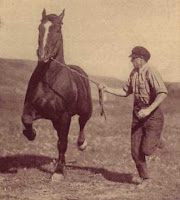
It also follows that people have to ask themselves, “Just what are those judges really looking for?” That is an important question because as some traits seem to be changing rapidly, others are not. Should judging criteria be based on new, improved horses or horses that represent what was the standard in the past, or some mix in-between? Without a standard, it is up to any one person’s opinion as to what to judge on, and it is hard to find ways to educate potential judges, breeders and owners as to what the ideal Percheron should look like. A breed standard would allow for judge education, something that is now mostly lacking within the Percheron Horse Association of America. Judge education is important because rated Percheron shows often determine those animals that will be the genetic stock for future generations.

One can’t preserve what hasn’t been defined. This thought is central to understanding why the Percheron Horse Association of America needs a breed standard. Some draft horse breeds have been progressive enough to have a standard already. Shires and Suffolk Punches are two such breeds and most people involved with these breeds are proud to have a breed standard.
Naysayers will argue that Percherons are too diversified to have a standard. But there are other breed registries that have dealt with this issue in a satisfactory manner. It is not impossible to write a standard for a breed that has gotten to the point where different types or lines have been developed. But it might be necessary to write the standard to define those differences. One only has to look to the Welsh Pony and Cob Society of America (WPCSA) to see an example of how this issue can be effectively handled with finesse and an awareness of the diversity of the breed. The WPCSA has four sections of Welsh ponies within their standard (two types of Welsh Mountain Pony, Sections A and B, and two types of Welsh Cob, Sections C and D). There is a lot of diversity between the four sections and yet, all four sections are considered one breed, with similar characteristics. These differences between the types have been successfully written into one standard. Welsh Ponies are shown with each type having their own halter classes as well as separate performance events. The WPCSA is a great example of how diversity can be worked into a breed standard. It should be considered carefully as a model for a breed standard that encompasses more than one type of horse within a breed.


When the children of our children’s children look out their window into the pasture, we hope that the vision of a herd of glorious Percheron mares meets their gaze. We wish to think that those mares will look like the very same mares that greet my eyes each morning. A breed standard will help make that goal a reality.

By: Jill Glasspool Malone, PhD and Robert W. Malone, MD, MS (written in 2008, edited 2010 -copyright 2008)

*All photos were taken in the 1800s or very early 1900s. Note that most of the Percherons on this page were from France, where there were strict breeding standards: with studs chosen from stables of Haras du Pin.

Friday, July 17, 2009

Blowing Rock, NC Drive and Ride

July, 2009.
We went to Blowing Rock with the Middle TN Carriage Club and our local group, FUNDRS. We took three Percherons, two dogs and five people (plus a whole bunch of camping and horse related stuff). There were 25 people, 17 horses and 15 dogs in all.

The first night we were there, Donnie laid out a cones course in the gravel parking lot and the brave-hearted or still sober crowd went out for some runs. Competition was friendly and the horses seemed glad to get out and socialize. Note the chariot style adopted by Robert -tha
t is one BIG horse to look over when running a cones course. I took a lot of photos and put most of them up on photobucket. You can see them all here (note these are "raw" photos -the good, the bad and the ugly):
http://s818.photobucket.com/albums/zz108/Cieloazure/Blowing%20Rock/
and (the family photos)
http://s818.photobucket.com/albums/zz108/Cieloazure/?start=all

The next day: Sherry, Karen, Robert and I went for a long drive in Cone Memorial National Park. We took Soleil, a four year old Percheron mare who did really well. It was good to catch up with both Sherry and Karen, two of my favorite people! I didn't take any photos of that trip but we all came back happy and really pleased with the way the horses behaved. Sherry's new little Morgan is a doll and just perfect for her.

Soon, our son Zach and his girlfriend Megan showed up from Maryland. Robert, Zach, Megan, Spencer and I went for a long ride and drive with the two horses in carts and Robert riding Joanna. We had a blast. It was a long, leisurely drive/ride through the park. Very civilized. Spencer did a great job driving Genie, despite his mother's "backseat driving" from the other cart.

We also played with the two dogs, Cloe and Aura. As sisters, they like to play all the time, as only Aussies can do. Aura and Cloe went around and around together, playing with their toy. When Cloe left, Aura got downright grumpy. She looked for her everywhere and then sulked as I have never seen her do before.


Zach, Megan and Robert went for a long trail ride that night. I heard words like "magical" used as well as "sore all over" to describe the trip. It is hard to decribe just how wonderful the rhodademdrums were when riding and driving. There were so many of them, in so many shades of pinks. Megan looked very tiny and very cute way up there on Genie.


That next morning, Spencer, Robert and I went for a ride and drive. Spencer filmed the trip and I put edited it and got it up on the web:


Final thoughts: Cone Memorial Park is exceptional for driving and riding. I hope that more people from the FUNDRS group can come next year! But remember to put on DEET or keep yourself covered, I have a zillion chigger bites on my feet!